

How to remove arsenic from water sounds like it should have a simple answer. Buy a filter, problem solved!
But most people who go looking for that answer end up more confused than when they started, buried in filter comparisons that skip the one question that actually determines whether any of it will work: which form of arsenic is in your water?
If you’re on a private well and your test just came back with an elevated result, this guide is for you. It’s also for anyone who bought an RO system thinking they’d handled it and wants to make sure they actually did. I’ll skip the filler and go straight to what the science says, what the certification labels really mean, and how to make a decision that fits your specific situation, whether you own your home or rent it.
If you’re on city water and your utility has confirmed it’s below the EPA limit, you’re probably fine. Your treatment plant handles arsenic before it reaches your tap. But if you’re on a well, that’s entirely on you. No one is testing it for you, and no one is treating it.
Where Arsenic in Well Water Actually Comes From

Arsenic in well water is almost never a pollution story. It dissolves naturally out of bedrock. Granite, shale, and sedimentary rock all release it slowly into groundwater over geological time. Agricultural chemicals and mining operations are secondary sources, but most cases of arsenic in well water have nothing to do with nearby industry. It’s just geology, and it can happen anywhere the rock chemistry is right.
About 2.1 million Americans drink domestic well water with arsenic above the EPA’s 10 ppb limit, according to USGS research. The Southwest is worst: 16% of wells sampled in that region exceeded the limit. Maine (18%), New Hampshire (14%), and Nevada (14%) have the highest rates of affected domestic-well users among individual states. Other hotspot regions include the upper Midwest and parts of southern Texas.
The EPA maximum contaminant level (MCL) for arsenic is 10 ppb, set in 2001 when the previous limit of 50 ppb was finally tightened. The MCL goal, which is the level EPA considers truly safe, is zero. The National Research Council estimated that lifetime consumption of water at exactly 10 ppb carries roughly a 1-in-300 excess risk of bladder or lung cancer. EPA chose 10 ppb over stricter options (3 ppb or 5 ppb) based on cost-benefit analysis, not purely on health science. If your well tests at 8 ppb, you’re technically under the limit, but you’re not in a risk-free zone.
Private wells are not regulated under the arsenic MCL. The rule only applies to public water systems. Testing and treatment are entirely the homeowner’s responsibility.
The Two Types of Arsenic in Well Water, and Why It Changes Everything
Arsenic in well water comes in two forms: arsenate (As V) and arsenite (As III). You don’t need to memorize the chemistry. What you need to know is this: As V is the easy one to filter out, and As III is the hard one. Most filters are built to handle As V. If your water has a lot of As III and you don’t know it, you could install an expensive system and still be drinking water above the safety limit.
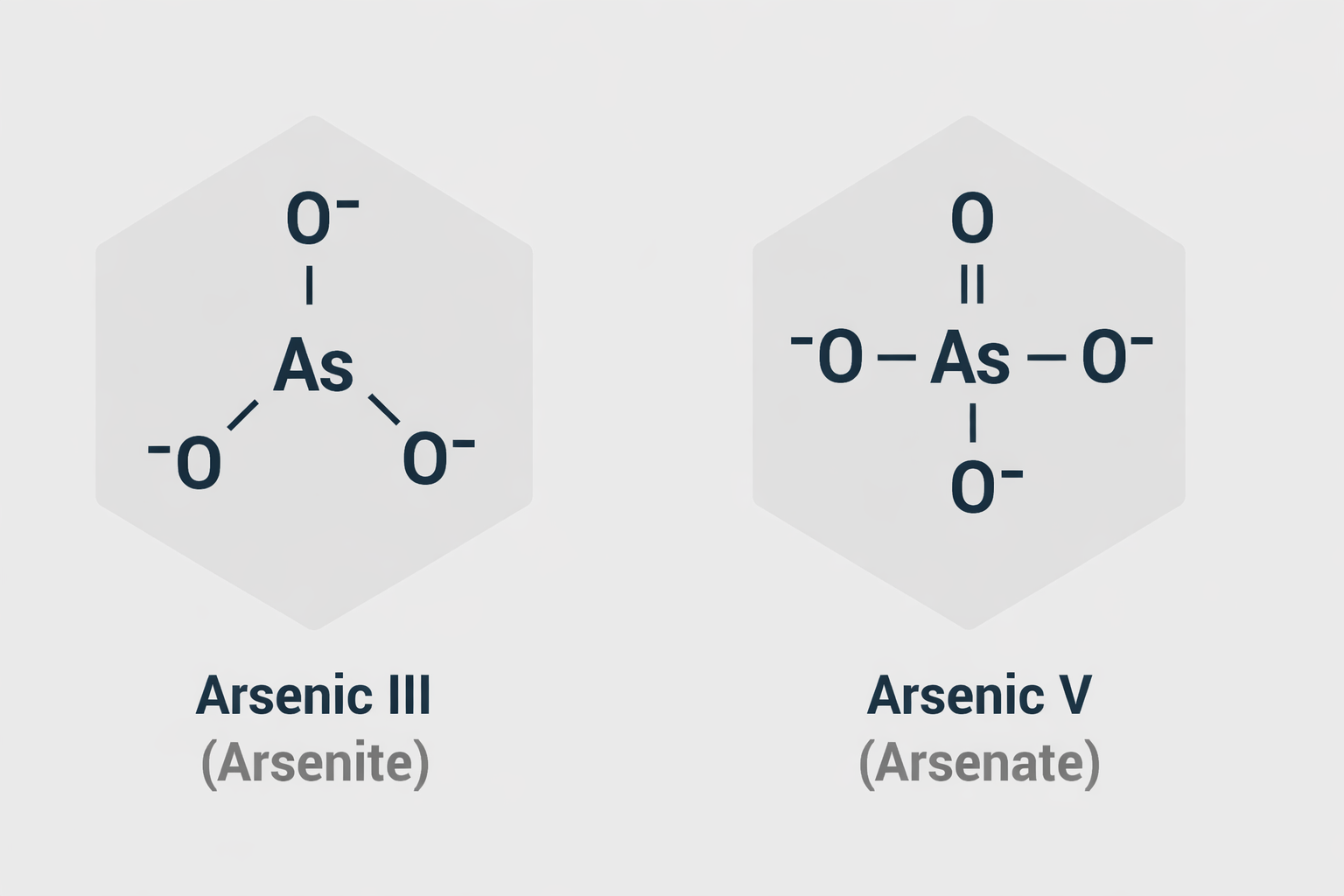
Here’s why; filters that trap arsenic (whether it’s an RO membrane, an alumina cartridge, or an ion exchange resin) mostly work by attracting charged particles. As V carries a charge, so these systems grab it readily. As III carries no charge at all, so it slips right through. RO removes 95–98% of As V. For As III, that drops to 60–65% in good conditions, and as low as 30–60% depending on the membrane and your water chemistry. Ion exchange resins can’t remove As III at all. The resin simply doesn’t “see” it.
This isn’t a theoretical problem. A real-world study of 19 homes in Nevada, all with certified RO systems installed on arsenic-contaminated wells, found that post-treatment arsenic still exceeded the safety limit in more than half the homes (Walker et al., PMCID: PMC3849398). Those homeowners did everything right on paper. They bought certified systems and installed them. They just didn’t know which form of arsenic they had.
Standard water tests report total arsenic, not which type. Your lab result is the sum of both forms combined. If it comes back at 15 ppb, you have no idea from that number alone whether your filter will catch 97% of it or only 62%. That gap is what this guide is here to help you close.
Which Filters Remove Arsenic from Water (and Which Ones Don’t)
Reverse osmosis
RO is the most widely available residential arsenic treatment and the right choice for most people, with two conditions: your arsenic is predominantly As V, or you add a pre-oxidation step to convert As III before it reaches the membrane.
For As V, certified RO systems consistently hit 95–98% removal (CT DPH). For As III, without pre-treatment, real-world removal can drop below 65% and in some conditions much lower. The fix is simple: chlorine (liquid bleach) added before the RO inlet converts As III to As V within one minute at standard residential pH levels (EPA, Arsenic Mitigation Strategies). Potassium permanganate works the same way. If your speciation test shows significant As III, pre-oxidation is not optional. It’s the difference between adequate treatment and false confidence.
RO systems also produce wastewater during operation (typically 3–4 gallons rejected per gallon produced on standard systems), require filter replacements every 6–12 months, and need annual membrane checks. They’re under-sink installations that require a dedicated faucet and a drain connection.
Activated alumina
Activated alumina is one of EPA’s seven designated Best Available Technologies for arsenic. At its optimal pH of 5.5–6.0, it removes up to 95% of As V. Performance drops as pH rises above 6.0, which limits it for some water sources. For As III, removal capacity is roughly 60–70%, so pre-oxidation is advisable here too when As III is present.
Maintenance is more involved than RO: the alumina media needs to be chemically regenerated over time, which most homeowners aren’t set up to do. Cartridge-based systems that use pre-packed alumina media and get swapped out entirely are far more practical. One advantage over ion exchange is that alumina is pickier about grabbing arsenic specifically. It’s less thrown off by other minerals in the water, like sulfate, so it works in a wider range of well water conditions.
Ion exchange (anion exchange)
Ion exchange resins work well for As V, hitting 90–100% removal under good conditions. But two things can go wrong. First, they can’t remove As III at all, for the same reason as above: no charge, no capture. Second, if your well water is high in sulfate (a common mineral), the resin fills up with sulfate before it can capture arsenic, burning through its capacity quickly.
There’s also a failure mode worth knowing about called “dumping.” When a spent ion exchange resin gets overwhelmed, it can actually release previously captured arsenic back into the water, briefly sending your arsenic levels higher than they were before treatment. That’s not common, but it’s a real risk if the system isn’t maintained on schedule. Ion exchange is best suited for cleaner well water where arsenic is predominantly As V and sulfate levels are low.
Activated carbon: Brita, PUR, and standard pitcher filters
Activated carbon does not remove arsenic. This includes Brita, PUR, and virtually every standard pitcher filter on the market. The same carbon-based filters that miss arsenic also miss fluoride entirely, we break down which water filters actually remove fluoride in a separate guide.
The University of Maine’s arsenic research program states it directly: “activated carbon is not much good for arsenic.” The Barnaby study tested eight household filtration products. Brita removed 19% of arsenic. PUR removed 26%. HDX removed 9%. These are not partial solutions. They’re functionally useless for arsenic removal at health-relevant concentrations. EPA does not include activated carbon among its Best Available Technologies for arsenic, which is the clearest signal: it is not a recognized treatment method for this contaminant.
If you’re using a standard carbon-based pitcher or faucet filter and your water has arsenic above the MCL, your filter is not helping you.
Distillation
Distillation removes virtually all arsenic, both As III and As V, and Health Canada confirms its effectiveness. The practical problem is that distillation is energy-intensive, slow, and mechanically more complex than RO. For most households, RO with pre-oxidation if needed is the better path. Distillation is a fallback if RO isn’t feasible for some reason.
The Certification Gap Nobody Warns You About

Every guide on this topic says “get an NSF 58 certified RO system” and leaves it there. That advice is incomplete in a way that matters.
NSF/ANSI 58 does not automatically cover arsenic. The core requirement of NSF 58 is reducing total dissolved solids (TDS), which is essentially the overall mineral content of water, by at least 75%. That’s the baseline every certified RO system must meet. Arsenic reduction is an optional contaminant claim that manufacturers may choose to test and certify for. Many do not.
This means a product can carry an NSF 58 certification label on the box and have zero testing or certification for arsenic specifically. NSF itself says it plainly on its consumer resources page: “Certification to an NSF/ANSI standard or protocol does not mean that a filter, purifier or treatment system will reduce all possible contaminants. It’s important to verify that the filter, purifier or treatment system is certified to the applicable standard for the reduction of the contaminants of most concern to you.”
The same gap exists for non-RO systems under NSF 53. A filter certified under NSF 53 for cyst reduction is not thereby certified for arsenic. Arsenic (pentavalent) was added as a specific claim under NSF 53 in 2003; arsenite wasn’t added until 2006.
How to actually check: Go to INFO NSF – search by manufacturer. Open the product listing. Look for “Arsenic (Pentavalent)” listed as a specific reduction claim under the certified contaminants. If it’s not there, the product is not certified for arsenic, regardless of what standard number appears on the packaging.
Trust me, this is worth the five minutes it takes. The same standard number can mean very different things for different products from the same manufacturer. Within Multipure’s product line, for example, the Aqualuxe, Aquaperform, and Aquapremier models list arsenic (pentavalent) as a certified claim under NSF 53, verified in the NSF database. The Aquamini and Aquaversa models from the same manufacturer, also NSF 53 certified, do not list arsenic. Same company, same standard, different coverage.
If you want a filter specifically certified for arsenic removal, Multipure’s NSF 53-certified line (Aqualuxe, Aquaperform, Aquapremier) is the clearest verified option currently listed in the database. These use carbon block with adsorption media rather than RO. For RO systems with verified arsenic-specific certification, use the NSF database search and filter by the arsenic contaminant claim rather than trusting what’s printed on a product page.
I’ve seen the same pattern with lead filters. The standard number on the box is the starting point, not the finish line.
How to Remove Arsenic from Water: Reading Your Test Results First

If you’re trying to figure out how to remove arsenic from well water specifically, the steps below are written with you in mind. Municipal water users can skip to Step 4 or the FAQ.
Step 1: Get a test that reports total arsenic. A standard lab panel will give you this. State-certified labs are the most reliable option; many state health departments maintain lists of approved labs. CT DPH confirms that standard tests report total arsenic, the sum of As III and As V combined.
Step 2: If total arsenic is at or near 10 ppb, request speciation. Speciation testing identifies the ratio of As III to As V in your water. Without this, you don’t know whether RO will give you 97% removal or 62%. For water between 5–25 ppb, where you might be borderline compliant but not risk-free, speciation is the data point that tells you how aggressive your treatment needs to be.
Step 3: Match treatment to concentration using CT DPH’s framework. For total arsenic below 100 ppb, point-of-use (POU) treatment at the drinking and cooking tap is generally sufficient. Arsenic enters the body primarily through ingestion, not skin contact or inhalation at typical household levels. For arsenic at or above 100 ppb, point-of-entry (POE) whole-house treatment is recommended to address bathing exposure as well. Above 500 ppb, contact your state health department directly.
Step 4: If As III is present and you’re using RO or ion exchange, add pre-oxidation. Household chlorination (regular liquid bleach, the same kind you’d use to disinfect a well) converts As III to As V within one minute at residential pH levels. This single step raises RO’s arsenic removal from the 60–65% range back up to 95–98%. Massachusetts DEP confirms chlorine as the most readily available oxidant for home water treatment.
Municipal water users: Your utility is regulated under the 10 ppb MCL and required to publish annual Consumer Confidence Reports. Check yours. If you’re on municipal water and within the limit, additional home treatment for arsenic is generally not necessary, though checking the report annually is worthwhile.
For more context on choosing between under-sink and countertop systems for overall water treatment, the countertop vs under-sink water filter comparison covers the installation trade-offs in detail.
If You Rent or Can’t Touch Your Plumbing
Options narrow considerably without plumbing access, but they don’t disappear. Renters dealing with arsenic in well water face a particular challenge: the most effective treatments all require some kind of permanent or semi-permanent installation.
The most important thing to know: no pitcher filter currently holds NSF or IAPMO certification for arsenic removal. That’s a documented fact from the Barnaby study, which noted at publication that “none of the tested pitcher filters are certified by the WQA or NSF to remove arsenic.”

The same study, however, produced the clearest lab data available on pitcher filter performance. ZeroWater uses a five-stage ion exchange deionization system rather than activated carbon. It reduced arsenic from 1,000 µg/L to below 3 µg/L in lab testing, and also removed naturally occurring arsenic from New Hampshire well water (42 µg/L to below detection). ZeroWater claims 99% arsenic reduction based on independent EPA-certified lab testing. That claim hasn’t been independently replicated in peer-reviewed conditions beyond the Barnaby study, and ZeroWater’s IAPMO certification covers lead, hexavalent chromium, PFOA, PFOS, and mercury. Arsenic is not on that list.
Faucet filters also fall short on PFAS, check our full breakdown on do faucet water filters remove PFAS?
So: strong lab evidence, no formal arsenic certification. If you’re a renter trying to remove arsenic from water without plumbing access, ZeroWater is the best-documented pitcher-format option available, but understand what you’re relying on. It’s lab data, not a certified standard.
We covered ZeroWater exclusively in this comparison regarding PFAS and fluoride removal.
Countertop RO units exist and don’t require under-sink installation. They sit on the counter and connect to the faucet via an adapter. They’re larger and more expensive than pitchers, but they bring certified RO performance without any plumbing work.
If your well is the specific source, our dedicated buying guide on the best water filter for arsenic in well water checks which certified RO and pitcher options actually have arsenic listed on their certificate, not just claimed on the box.
The same countertop RO units that handle arsenic also remove nitrates, another common well water contaminant that carbon filters miss entirely. If nitrates are a concern alongside arsenic, our guide on whether water filters remove nitrates is worth reading before you buy.
How to Verify a Filter Will Actually Remove Arsenic from Water
This is the checklist. Follow it before purchasing anything marketed for arsenic removal.
- Go to INFO NSF
- Search by manufacturer name
- Open the specific product model (not just the brand)
- Look for “Arsenic (Pentavalent) Reduction” listed under certified contaminants
- Note the specific standard (NSF 53 for non-RO, NSF 58 for RO) and confirm arsenic appears, not just the standard number
If arsenic doesn’t appear in the certified claims list, the product is not certified for arsenic removal. The standard number alone tells you nothing about contaminant-specific coverage.
For IAPMO-certified products, the equivalent search is at IAPMO. The same principle applies: find the specific product listing and confirm arsenic is listed among certified reduction claims.
One practical note: certification databases update when products are added, renewed, or removed. A product that was certified last year may have lapsed. Check the database at purchase time, not the manufacturer’s website or Amazon listing.
Frequently Asked Questions
What is the most effective way to remove arsenic from water?
Reverse osmosis certified for arsenic (confirmed in the NSF database, not just NSF 58 labeled) removes 95–98% of arsenate (As V). If your water contains significant arsenite (As III), add pre-oxidation. Liquid bleach converts As III to As V in under one minute. For renters without plumbing access, ZeroWater’s ion exchange pitcher has the strongest lab evidence, but it is not NSF-certified for arsenic.
Does a Brita filter remove arsenic?
Brita filters do not remove arsenic in any meaningful amount. A peer-reviewed study (Barnaby et al. 2017, Environmental Research) found Brita removed only 19% of arsenic in testing. Standard activated carbon, which Brita uses, is not recognized by EPA as a treatment technology for arsenic. If your water has elevated arsenic, a Brita filter will not protect you.
What does “NSF 58 certified” mean for arsenic?
It means the RO system met NSF’s core requirement for TDS reduction (75% minimum). It does not automatically mean the system is certified to remove arsenic. Arsenic is an optional contaminant claim under NSF 58. To verify arsenic coverage, search the specific product at info.nsf.org and confirm “Arsenic (Pentavalent)” appears in the certified contaminants list.
Does boiling water remove arsenic?
No. Boiling concentrates arsenic rather than removing it. As water evaporates, arsenic remains behind in higher concentration. Dartmouth College’s arsenic resource states this directly. Boiling is appropriate for bacterial or viral contamination. It does nothing for heavy metals or metalloids like arsenic.
What arsenic level should I be concerned about?
The EPA limit is 10 ppb, but the EPA’s own maximum contaminant level goal is zero, acknowledging no level is completely safe. The National Research Council estimated a 1-in-300 lifetime cancer risk at 10 ppb and 1-in-1,000 at 3 ppb. If your well tests above 5 ppb, treatment is worth considering. If it’s above the MCL, treatment is necessary.
How often should I test my well water for arsenic?
Test at least annually. Arsenic levels in well water can change seasonally and over time as water table levels shift and rock chemistry interacts with groundwater differently. After installing any treatment system, test again to confirm it’s working, then retest every 1–2 years after that. Many state health departments offer low-cost or subsidized testing for private well owners.