
Best shower filter for chloramine is one of the most searched phrases in shower filtration, and (by no surprise) the most misleading. Every product you see marketed as a “chloramine shower filter” is selling you a promise that no manufacturer has independently proven. Not one shower filter on the market holds third-party certification for chloramine removal. Not from NSF. Not from IAPMO. Not from anyone.
That does not mean the situation is hopeless. It means you need to understand the chemistry before you spend money, because the difference between chlorine and chloramine is the difference between a filter that works and one that does nothing.
Who this is for and who should look elsewhere
If your water utility uses chloramine (monochloramine) as its disinfectant, you have noticed dry skin, brittle hair, or respiratory irritation in the shower, and you want to know which filters have the best chance of reducing chloramine exposure based on available evidence.
Look elsewhere if: your utility uses free chlorine only. In that case, any NSF 177 certified shower filter will do the job. You can check what your water system uses by searching your city’s annual water quality report or calling your utility directly.
Also look elsewhere if: you want guaranteed, lab-certified chloramine removal. That product does not exist yet. The best you can do right now is choose a filter whose media has the strongest chemical basis for chloramine reduction, and this article covers exactly that.
Wait, What Is Chloramine?
Since you’re here, you probably already know, but to go through this quickly; Chloramine is what happens when your water utility mixes chlorine with ammonia. They do it because it lasts longer in the pipes and produces fewer byproducts than chlorine alone. The downside is that it is harder to filter out, it can dry your skin and hair the same way chlorine does, and it releases vapors in a hot shower that may irritate your lungs over time. If your water smells faintly like a pool but you cannot get the smell to go away by letting a glass sit out, that is a good sign you are on chloramine rather than chlorine.
How to Find Out If Your Water Has Chloramine
Before buying a shower filter for chloramine, confirm that chloramine is actually what you are dealing with. Most people assume their water has chlorine when it could be chloramine, or vice versa. The distinction changes which filter media will work.
The fastest way is to search “[your city] annual water quality report” and look for the disinfection method section. If you see “chloramine,” “monochloramine,” or “chloramination,” your utility uses chloramine. If you see “chlorine” or “chlorination” only, standard shower filters will work fine.
You can also call your water utility directly. Or, if you want to test your water yourself, a DPD colorimeter (like the Hach Pocket Colorimeter or Extech EX800) measures both free and total chlorine. The gap between those two numbers is your combined chlorine, which is mostly chloramine.
SimpleLab/Tap Score points out that even within chloraminated systems, the ratio of free chlorine to chloramine at your tap varies by distance from the treatment plant, water age in the pipes, and seasonal temperature changes.
If you find out your water does use chloramine and you want to filter it from your drinking water too, a reverse osmosis system or a filter certified to NSF 42 for chloramine will handle it effectively at the kitchen tap.
Why Most Shower Filters Cannot Remove Chloramine
About one third of U.S. public water systems use chloramine as their residual disinfectant, affecting more than 68 million Americans. Chloramine is formed by combining chlorine with ammonia, producing a compound that is far more chemically stable. It does not evaporate by standing or boiling the way free chlorine does, and it resists the redox reactions that standard filter media depend on.
Most shower filters use KDF-55, a copper-zinc alloy that converts free chlorine into harmless chloride through a redox reaction. KDF works well for chlorine. For chloramine, it is essentially inert. SimpleLab/Tap Score confirms that KDF “cannot remove chloramines.”
Standard granular activated carbon (GAC) can technically decompose chloramine through a slow catalytic surface reaction. The problem is time. The Water Quality Association’s chloramine fact sheet notes that GAC requires at least 10 minutes of contact time to break down chloramine effectively. A shower filter provides less than one second. On top of that, GAC adsorption capacity drops 40 to 60% at typical shower temperatures of 100 to 110°F.
This is the core issue. The two most common shower filter media, KDF and standard carbon, were designed for free chlorine. If your water has chloramine, neither will do much.
What Most Articles Get Wrong About Chloramine Shower Filters
Nearly every “best shower filter for chloramine” list on the internet recommends products that do not address chloramine at all. They rank KDF-based filters, call them “chloramine filters,” and move on. Some even cite NSF 177 certification as evidence, which is particularly misleading.
NSF/ANSI Standard 177 tests exclusively for free available chlorine. The test water must contain less than 0.1 mg/L of chloramines. Every NSF 177 certified filter is required to carry this mandatory disclosure: “This system has not been evaluated for free available chlorine reduction performance in the presence of chloramines.”
That disclosure appears on the Aquasana AQ-4100 performance data sheet. It appears on every certified shower filter. Yet most buying guides never mention it.
Some brands go further. Filterbaby claims on Amazon to “reduce up to 98% of chloramine” and lists “IAPMO Certified to NSF 177 Standard” as evidence. But NSF 177 does not test for chloramine. This is the kind of gap between marketing and reality that CleanFaucet exists to expose.
Which Filter Media Actually Works for Chloramine
Three types of media have at least some scientific basis for chloramine reduction. None of them has been independently certified for it in a shower filter, but the chemistry behind each one varies significantly in how promising it is.
Vitamin C (ascorbic acid) is the strongest theoretical candidate. The USDA Forest Service confirmed that 1 gram of ascorbic acid neutralizes 1 mg/L of chlorine per 100 gallons of water. The San Francisco Public Utilities Commission confirmed that 1,000 mg of vitamin C removes chloramine completely in a bathtub, but noted it requires 4 to 8 minutes of contact time.
The open question is whether flowing shower water provides enough contact time. One consumer test by InspiredLiving using an Extech EX800 colorimeter found a Vitashower SF-1 vitamin C filter achieved 99% total chlorine removal in chloramine-heavy water. A competing test by Envig, a catalytic carbon filter manufacturer, found vitamin C had “zero effects” on chloramine at shower flow rates. Both tests have limitations: the InspiredLiving test used consumer-grade equipment, and the Envig test carries obvious bias since they sell a competing product.
Catalytic carbon decomposes chloramine through a two-step catalytic reaction, converting it to nitrogen gas and chloride. Filtrex Technologies reports it has five times the service life of standard GAC for chloramine in point-of-use applications. But no shower filter using catalytic carbon has been independently certified for chloramine performance at the high flow rates and temperatures involved. Aquasana sells an AQ-4100C model using catalytic carbon media in Europe that claims chloramine reduction, but that model does not appear available on Amazon US.
Solid carbon block (used in the Weddell Duo) provides more surface area and longer contact time than loose granular carbon. It has not been tested for chloramine specifically, but its denser structure offers a better theoretical chance of decomposition than GAC.
Chlorgon (Sprite’s proprietary calcium sulfite, zinc, and copper media) is primarily designed for free chlorine. Sprite does not claim chloramine removal. However, the InspiredLiving consumer test measured 99% total chlorine removal from chloramine-heavy water using a Sprite HOC cartridge. That result is surprising given the media chemistry, and it has not been replicated in a professional lab setting.
4 Shower Filters to Remove Chloramine
No certified option exists for chloramine, so the best shower filter for chloramine is the one whose media has the strongest chemical basis for dealing with it. Here are four products, ranked by how directly they address the chloramine problem.
Our top pick
Sonaki VitaPure Inline Vitamin C Shower Filter
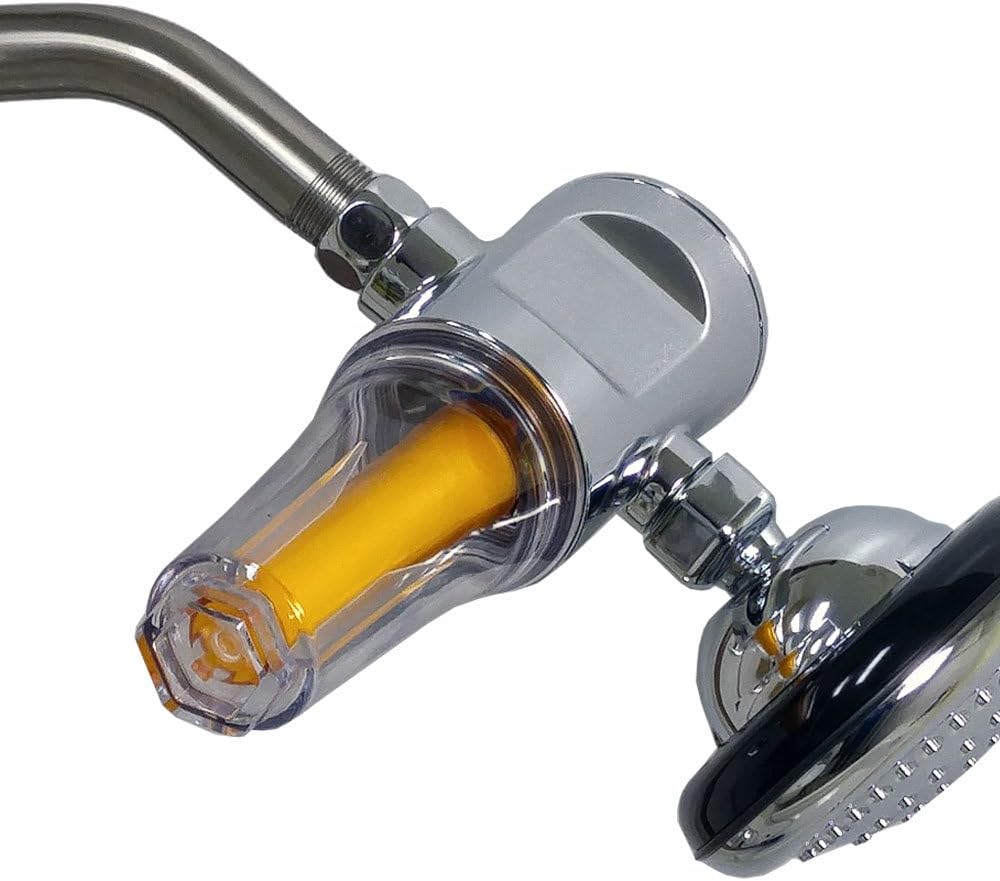
Media: 100% food-grade vitamin C (ascorbic acid)
NSF/IAPMO certification: None
Manufacturer chloramine claim: 99.9% chlorine and chloramine removal. This claim has not been independently verified.
Vitamin C is the only shower filter media backed by government documentation for chloramine neutralization. The USDA and SFPUC have both confirmed the chemical mechanism. The practical question is contact time, and the evidence is conflicting. The InspiredLiving consumer test showed 99% total chlorine removal; the Envig manufacturer test showed zero chloramine effect.
This filter makes the most sense if you are on chloramine water and want the best theoretical shot at reducing it. The tradeoff is cost. Cartridges deplete in 4 to 8 weeks depending on usage, making this the most expensive option per year by a wide margin. The all-plastic housing has drawn durability complaints from Amazon reviewers, and the see-through design lets you monitor vitamin C depletion visually.
If you already use a water filter pitcher that removes PFAS and fluoride for your drinking water, adding this for your shower gives you coverage at both points of contact.
2. Weddell Duo Shower Filter
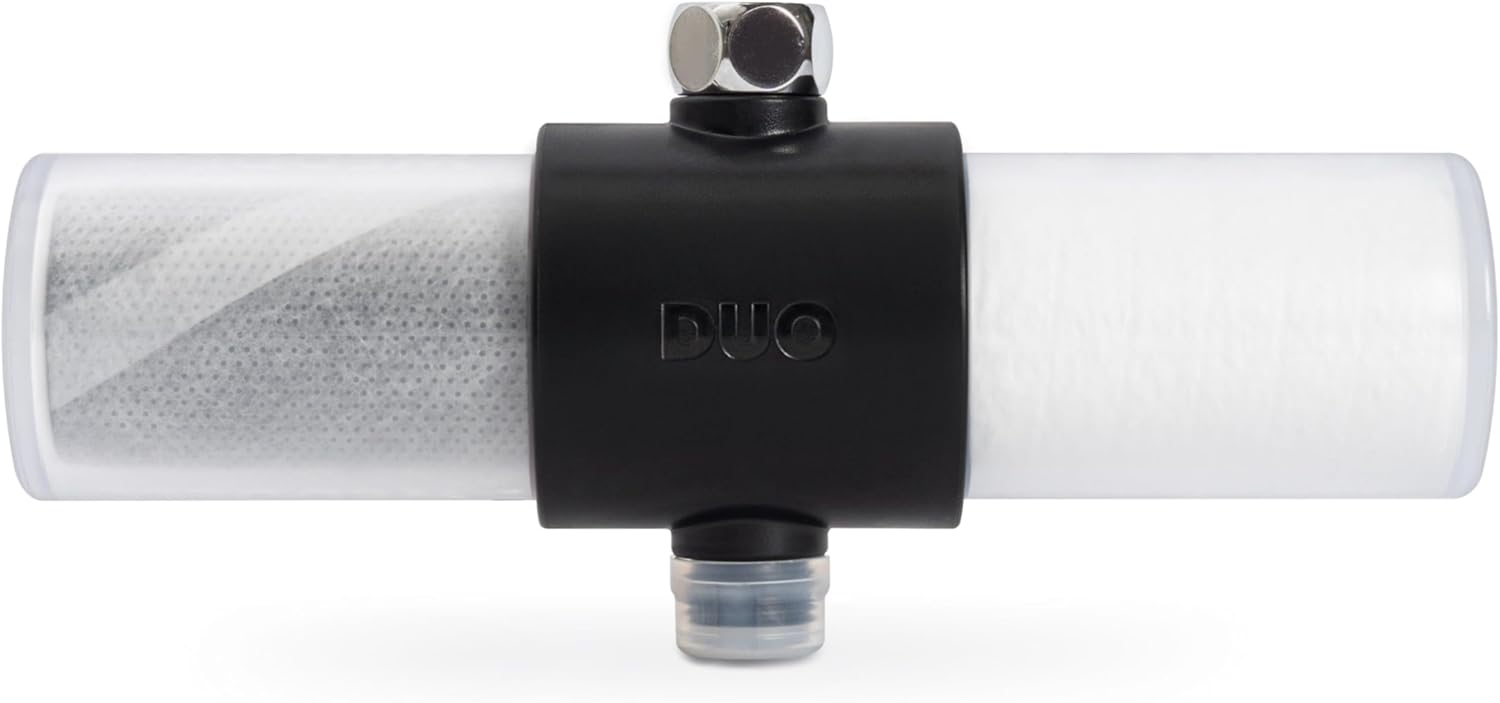
Media: Solid activated carbon block + sediment pre-filter (dual cartridge)
NSF/IAPMO certification: NSF/ANSI 177 certified (verified in NSF database). NSF/ANSI 372 (lead-free). PFAS and particulate reduction verified by IAPMO R&T under NSF 42 and 53.
Manufacturer chloramine claim: None. Weddell only claims free chlorine reduction.
This is the most rigorously tested shower filter available. In WaterFilterGuru’s independent lab testing with SimpleLab, the Weddell Duo achieved 100% chlorine removal and 100% elimination of all four disinfection byproducts tested. No other shower filter matched both numbers.
It is not marketed as a chloramine filter, and it has not been tested for chloramine. But the solid carbon block design provides significantly more contact time than loose granular carbon. If you want the most verified filtration performance available for everything except chloramine, and a reasonable theoretical basis for some chloramine reduction, the Weddell Duo is the strongest pick. The dual clear housings let you see when cartridges need replacing, and installation is tool-free.
If you’re weighing it against the other shower filter it gets compared to most, our Weddell Duo vs Jolie shower filter comparison breaks down the certification and cost gap between the two.
3. Aquasana AQ-4100 Shower Filter
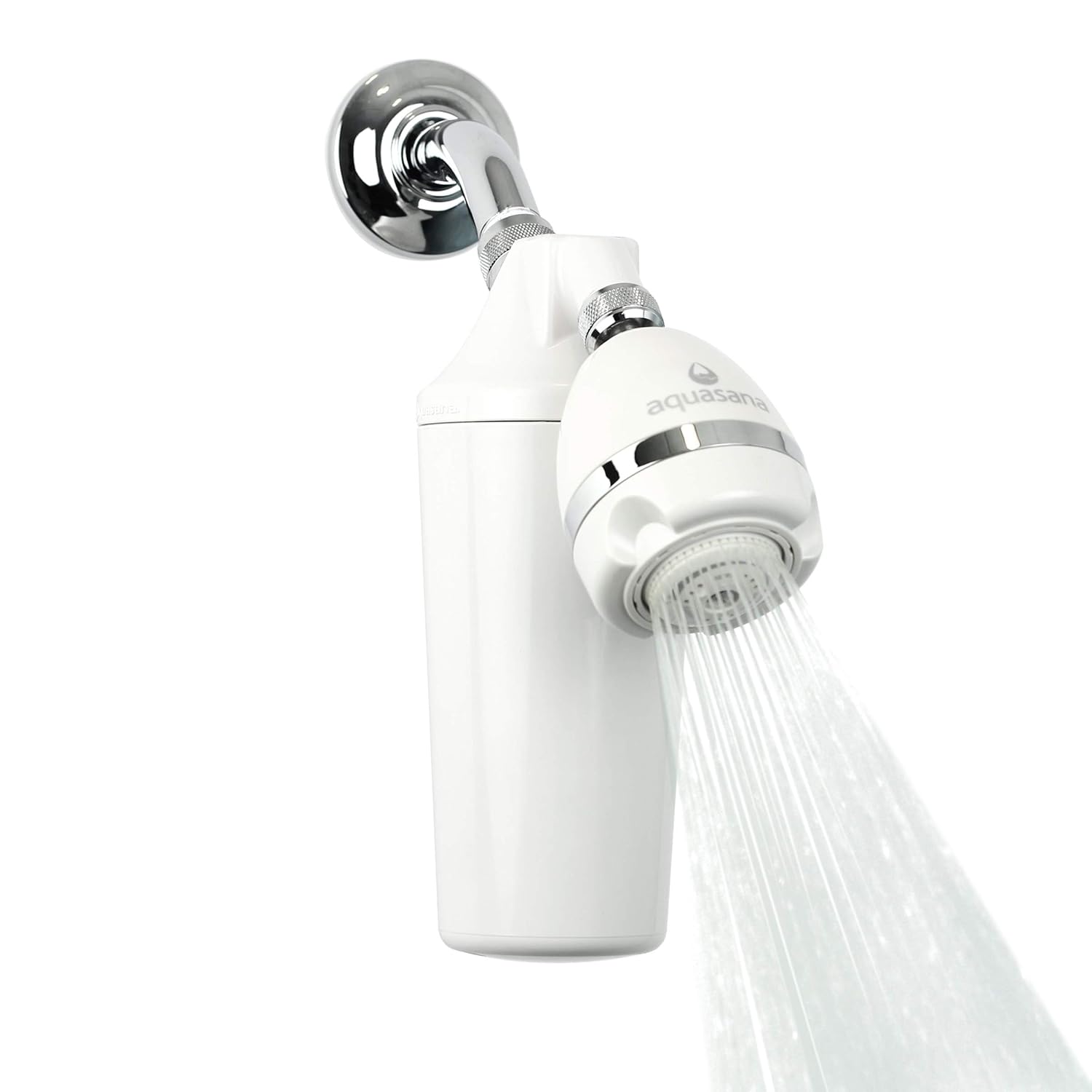
Media: Stage 1: KDF-55D (copper-zinc). Stage 2: Coconut shell activated carbon.
NSF/IAPMO certification: “Independently tested to NSF/ANSI Standard 177” but NOT listed in NSF’s certified product database. Media certified to NSF/ANSI 61 (materials safety only).
Manufacturer chloramine claim: None. Performance data sheet explicitly disclaims chloramine evaluation.
Aquasana is the most recognized shower filter brand, and its AQ-4100 is a solid chlorine filter. WaterFilterGuru’s lab data showed 100% chlorine removal but only 73% THM (disinfection byproduct) reduction.
This filter is included here as the market leader and a point of comparison. It does not address chloramine. The KDF-55 media has no mechanism for chloramine reduction, and the GAC stage does not provide enough contact time to decompose it. The InspiredLiving test measured only 36% total chlorine removal when tested on chloramine-heavy water, compared to 99% for vitamin C and Chlorgon-based filters.
If your countertop or under-sink filter handles your drinking water and you just need a reliable shower filter for chlorine, the Aquasana works. For chloramine specifically, look at the Sonaki or Sprite instead.
Aquasana sells a chloramine-specific model (AQ-4100C) using catalytic carbon in Europe. That model is not currently available on Amazon US and has no published third-party certification for chloramine performance.
4. Sprite HO2-WH High Output 2 Shower Filter
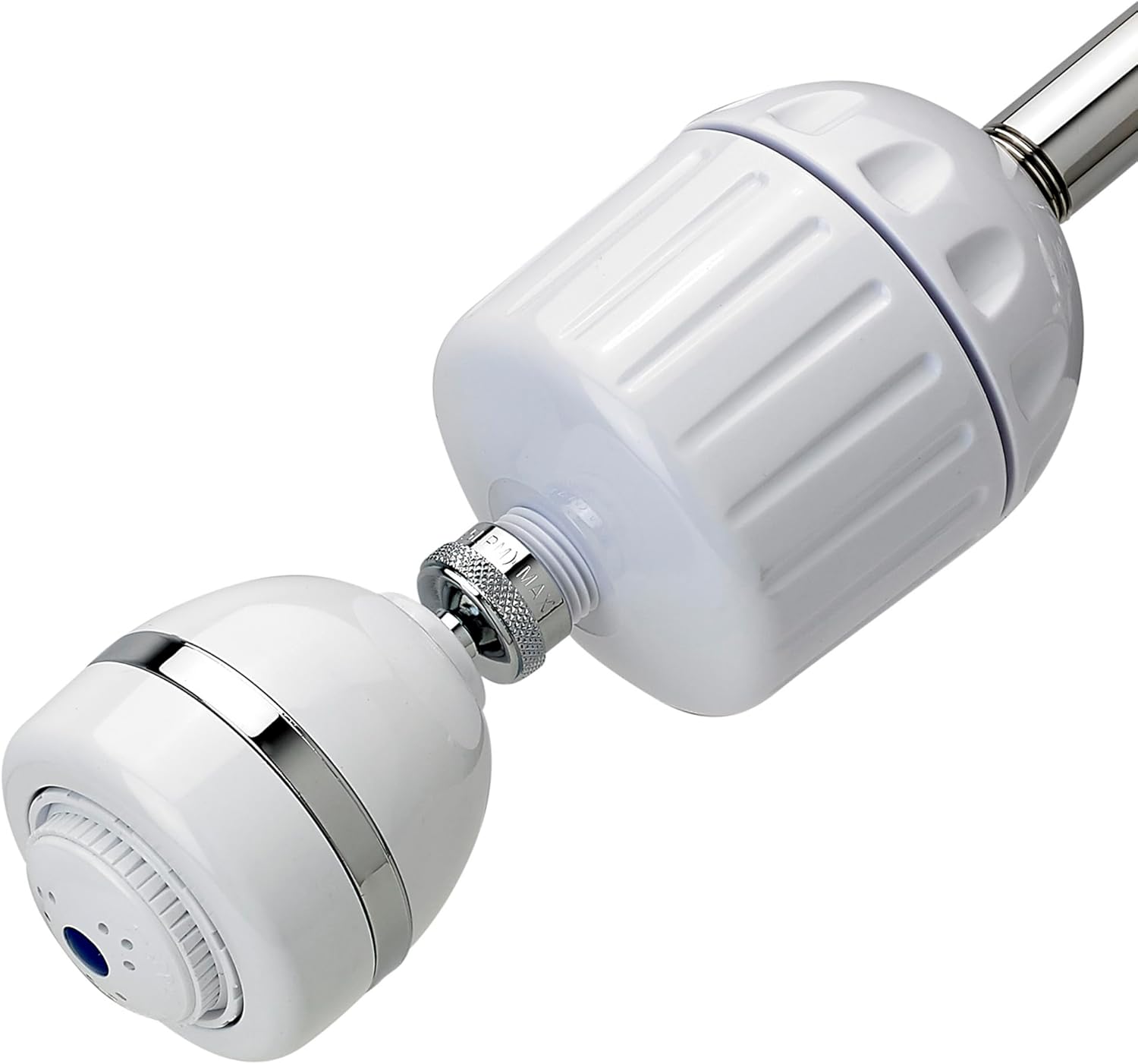
Media: Chlorgon (proprietary calcium sulfite, zinc, copper blend) + KDF-55
NSF/IAPMO certification: IAPMO certified to NSF/ANSI 177 for chlorine reduction
Manufacturer chloramine claim: None. Sprite does not claim chloramine removal.
Sprite is the budget pick, and it comes with an interesting wrinkle. While Sprite does not claim chloramine removal, and the Chlorgon media is technically designed for free chlorine, the InspiredLiving consumer test measured 99% total chlorine removal in chloramine-heavy water. That includes combined chlorine, which is what chloramine registers as on a total chlorine test.
That single test has not been replicated in a professional lab, and Sprite itself does not make chloramine claims. But at $30 to $40 upfront and roughly $15 per year in replacement costs, this is the lowest-risk option if you want to try a filter on chloramine water without committing to the annual cost of a vitamin C system. The reversible cartridge design effectively doubles service life, rated at 12 months or 25,000 gallons per cartridge.
What Shower Filters for Chloramine Actually Cost
| Filter | Upfront Cost | Annual Filter Cost | Total Year 1 Cost |
|---|---|---|---|
| Sonaki VitaPure | $45 to $65 | $130 to $180 | $175 to $245 |
| Weddell Duo | $87 to $90 | $60 to $80 | $147 to $170 |
| Aquasana AQ-4100 | $72 to $84 | $90 to $104 | $162 to $188 |
| Sprite HO2-WH | $30 to $40 | $15 to $16 | $45 to $56 |
Aquasana’s annual cost can drop significantly with third-party compatible cartridges available on Amazon for roughly $15 to $20 per two-pack. The Sonaki VitaPure has the highest ongoing cost because the vitamin C cartridge depletes in 4 to 8 weeks. Sprite’s reversible cartridge design keeps long-term costs the lowest of any option reviewed.
The Honest Bottom Line on Shower Filters and Chloramine
Dr. Meg Christensen at Interior Medicine puts it clearly: “No shower filters are officially certified for chloramine removal, meaning product claims about chloramine aren’t verified by any lab.” SimpleLab/Tap Score goes further: “There are no significant studies or evidence that show that shower filters are capable of removing chloramines.”
That is the reality. The best shower filter for chloramine is a category where the industry has not caught up with the chemistry. No product has proven it can do the job under real shower conditions with independent lab verification.
What you can do is choose the filter with the strongest scientific basis for chloramine reduction. Vitamin C has the most documented mechanism. Solid carbon block has the best contact time profile. Sprite’s Chlorgon media produced a surprising consumer test result that has not been explained or replicated.
The one option that reliably removes chloramine from shower water is a whole-house catalytic carbon system or a whole-house reverse osmosis system. Both are expensive, and neither is practical for renters. If you are renting and want to reduce chloramine exposure at the shower, the Sonaki VitaPure is the most chemically logical choice, and the Sprite HO2-WH is the most cost-effective gamble.
If you want to understand how filter expiration affects PFAS levels or why certification does not always equal performance, those topics connect directly to the certification gaps exposed in this article.
Common Questions
Does the best shower filter for chloramine actually exist?
No shower filter currently holds independent certification for chloramine removal. NSF/ANSI Standard 177, the only certification for shower filters, tests exclusively for free chlorine and explicitly excludes chloramine. The best available options use vitamin C or solid carbon block media, which have some scientific basis for chloramine reduction but no verified lab data at shower flow rates.
What is the difference between chlorine and chloramine in tap water?
Chlorine is a simple disinfectant that dissipates quickly. Chloramine is chlorine bonded with ammonia, making it far more stable. About one third of U.S. water systems use chloramine, affecting over 68 million people. Standard shower filter media like KDF-55 and granular activated carbon work on chlorine but fail on chloramine because the chemical bond requires different reaction conditions or much longer contact time.
Can a vitamin C shower filter remove chloramine?
Vitamin C (ascorbic acid) is the only shower filter media with government-documented evidence of chloramine neutralization. The USDA and SFPUC have confirmed the chemistry. However, flowing shower water may not provide the 4 to 8 minutes of contact time needed for complete chloramine neutralization. One consumer test showed 99% total chlorine removal; a competing test showed zero chloramine effect. The evidence is conflicting.
How do I know if my water has chloramine?
Search your city’s annual water quality report online and look for “chloramine” or “chloramination” in the disinfection section. You can also call your utility. For home testing, a DPD colorimeter measures free and total chlorine separately. The difference between those readings represents combined chlorine, which is primarily chloramine.
Is KDF-55 effective against chloramine?
KDF-55 converts free chlorine to chloride through a redox reaction and works well for that purpose. It has no meaningful mechanism for breaking down chloramine. SimpleLab confirms that KDF “cannot remove chloramines.” If your water uses chloramine, a KDF-only shower filter will not address it.
Do I need a whole-house system to remove chloramine from shower water?
A whole-house catalytic carbon filter or reverse osmosis system is currently the only reliable, proven method for removing chloramine from all water in the home, including shower water. These systems provide the contact time and media volume that compact shower filters cannot. For renters or anyone who cannot install whole-house treatment, a vitamin C shower filter is the most chemically logical point-of-use alternative, though independent verification is lacking.