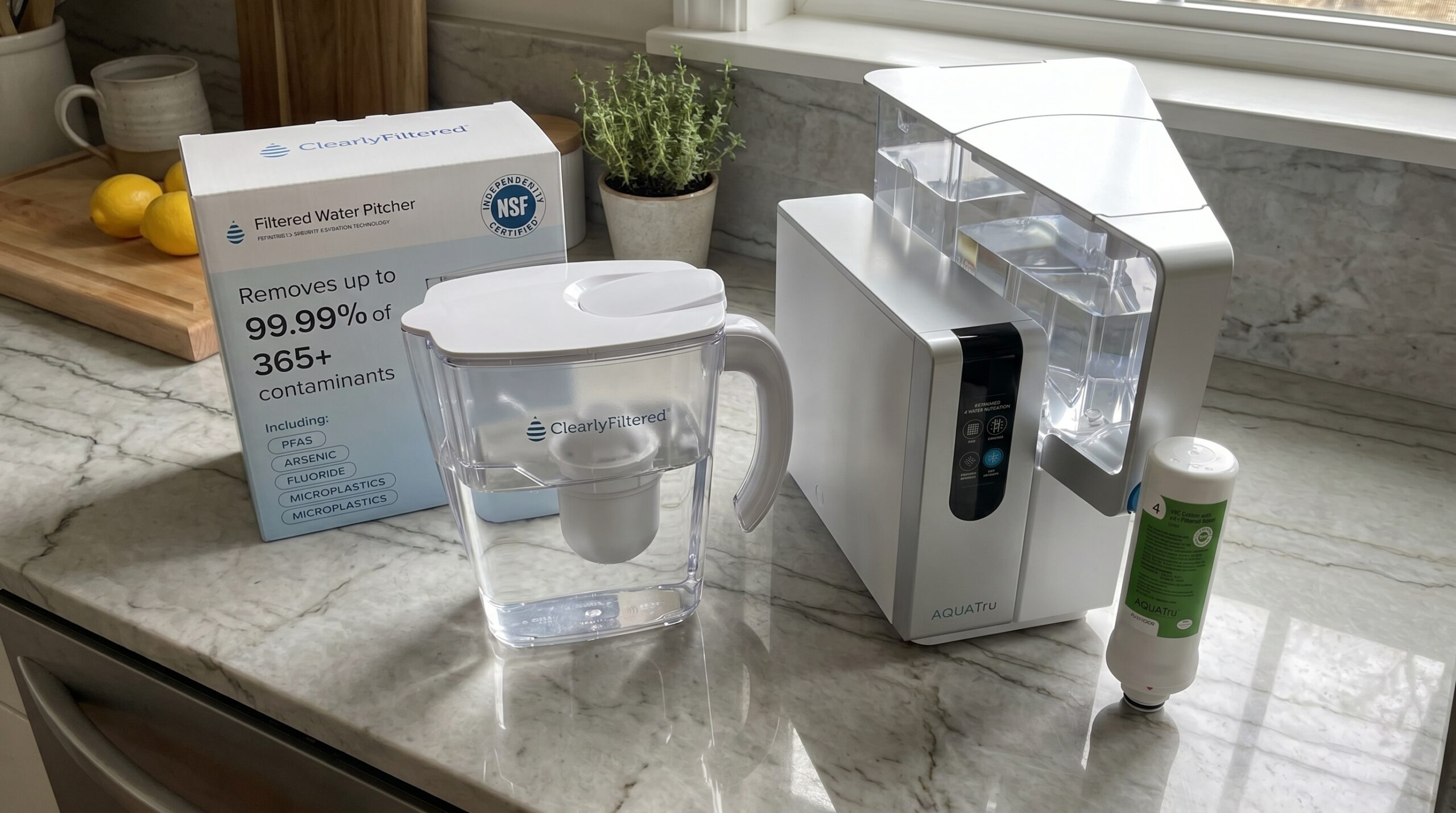
AquaTru vs Clearly Filtered is the comparison that comes up constantly for renters and apartment dwellers trying to get serious about their water without touching a single pipe. Both are no-installation, both remove PFAS and lead, and both get recommended all over the internet. The difference between them, once you look at the actual certification records and independent lab data, is more significant than most side-by-sides let on.
This is not a tie. But the winner depends almost entirely on what you are trying to remove and what you are willing to spend upfront.
If you are on a lease and cannot drill anything, you are basically choosing between a countertop reverse osmosis machine that costs $449 and a pitcher that costs $100. Both work. The question is how much of that you can actually verify independently, and whether the gap matters for your specific situation.
If you are renting and your water report shows PFAS, lead, or fluoride, this comparison is written for you. Same if you have been using a Brita and are wondering whether either of these is worth upgrading to. If you own your home and can install plumbing, an under-sink reverse osmosis system will outperform both of these at a lower cost per gallon over time, and that is probably the better conversation to have first.
Neither product handles nitrates meaningfully. Neither is built for whole-house coverage. If those are your concerns, you are looking at the wrong category.
The Certification Gap Most Comparisons Skip
The AquaTru vs Clearly Filtered comparison looks like a coin flip in most roundups. Dig into the certification databases and it is not.
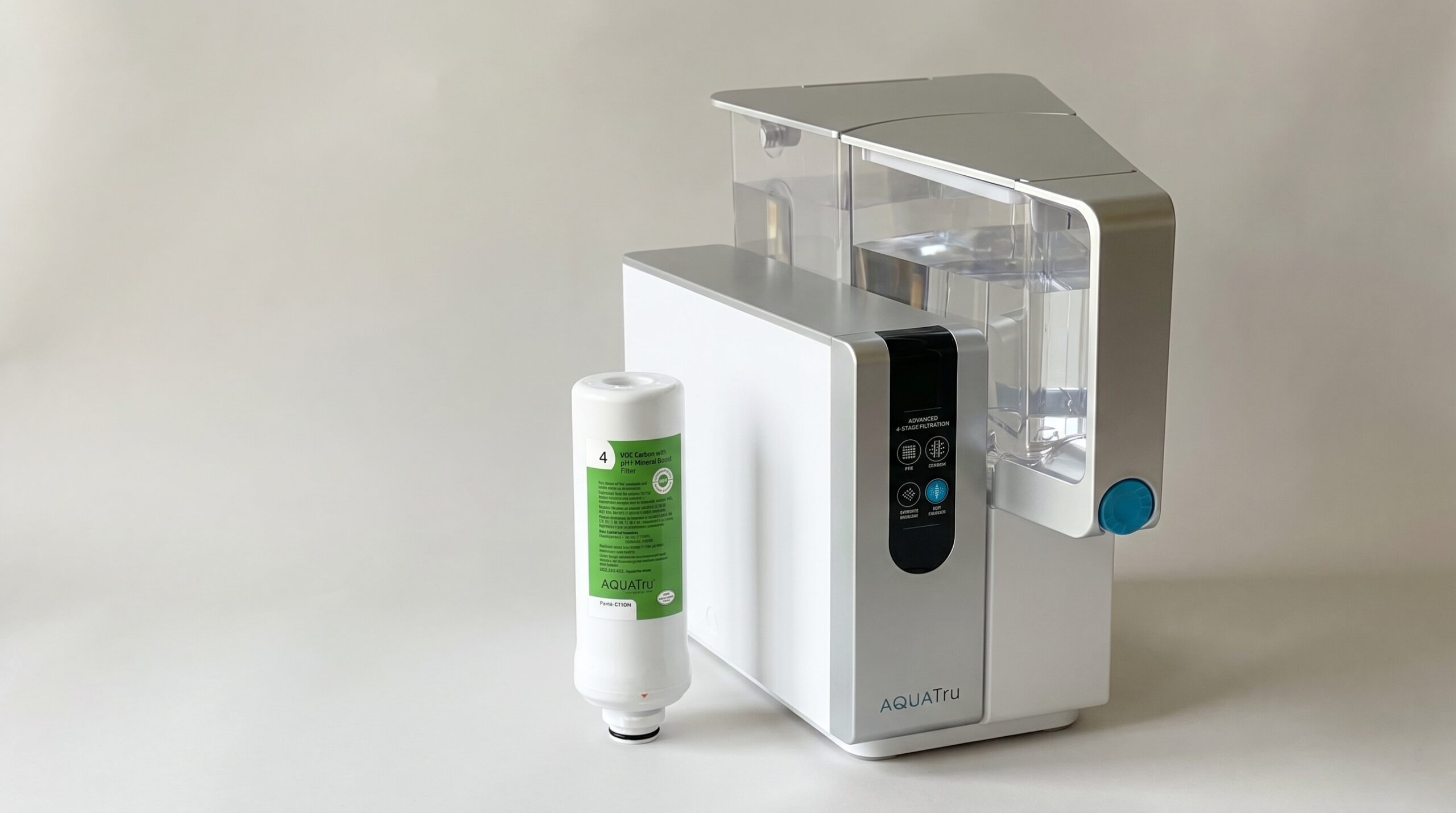
AquaTru Classic holds active IAPMO certification to NSF/ANSI 42, 53, 58, 401, and P473. That is five separate standards covering chlorine reduction, health-effect contaminants including lead and PFAS, reverse osmosis membrane performance, emerging contaminants, and PFOA/PFOS specifically. Every removal claim the company makes has a certification number behind it.
Clearly Filtered currently holds active certification to two standards: NSF/ANSI 42 for chlorine taste and odor, and NSF/ANSI 372 for lead-free materials construction. The 372 certification means the pitcher itself will not leach lead into your water. It does not certify that the filter removes lead from your water. That distinction matters enormously, and most reviews skip it entirely.
Clearly Filtered previously held a WQA certification to NSF/ANSI 53 for PFOA and PFOS reduction. As of February 2026, that certification no longer appears in the public database. The company is transferring certifications from WQA to NSF and has confirmed it is reapplying for PFAS certification under newly revised NSF standards (DNYUZ/Wirecutter, February 28, 2026). Until that process completes, the PFAS removal claim is supported by independent lab testing but not by an active third-party certification.
This is not a reason to avoid Clearly Filtered. It is a reason to know exactly what you are buying.
What AquaTru vs Clearly Filtered Actually Removes
Both products sit at the top of the best no installation water filter category for renters. Where they part ways is the contaminant list, and specifically fluoride and arsenic.
AquaTru removes fluoride at 93.5 to 97.88% via its reverse osmosis membrane. This is physics, not chemistry. The RO membrane pore size is approximately 0.0001 microns, and fluoride ions cannot pass through it. The removal is certified under NSF/ANSI 58 per the IAPMO R&T database and AquaTru’s own performance data sheet.
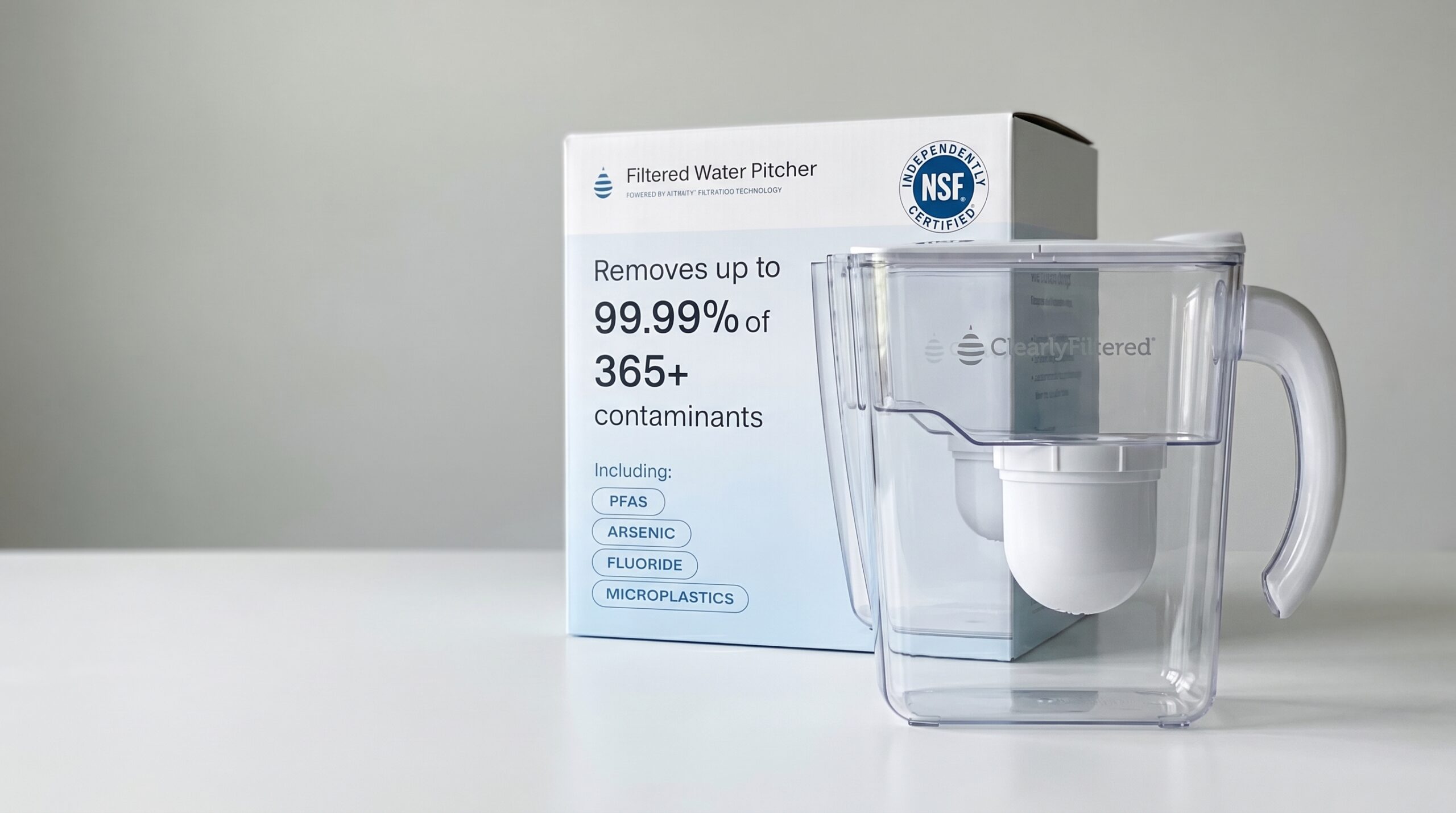
Clearly Filtered also removes fluoride, and this is the single biggest error in almost every AquaTru vs Clearly Filtered article published. A 2025 peer-reviewed study in the Journal of Public Health Dentistry (Hazzazi et al., DOI 10.1111/jphd.12649) tested nine pitchers against Indianapolis tap water at a 1.1 ppm fluoride baseline. Clearly Filtered was one of only two filters that achieved statistically significant fluoride reduction, and it produced the single largest reduction of any filter tested. The study’s honest caveat: “No filter was able to completely remove fluoride from tap water, contrary to the claims made by three manufacturers.” The realistic figure is high-90s percent. The “100%” claims you will see on some retailer pages are overstated.
On PFAS, both products perform well in testing. AquaTru eliminated PFAS to non-detect in WaterFilterGuru’s independent Tap Score testing. Clearly Filtered claims 99.5% PFAS removal, though as noted above, that claim is currently tested-to rather than actively certified [MANUFACTURER CLAIM, INDEPENDENT VERIFICATION NEEDED given the lapsed WQA certification].
On lead, AquaTru is certified at 99.9% removal under NSF/ANSI 53. Clearly Filtered shows 99.3% in manufacturer testing, with active NSF 53 certification pending the WQA to NSF transfer.
Where AquaTru clearly separates itself: arsenic at 98% and chromium-6 at high-90s, both certified under NSF/ANSI 58. If either contaminant shows up in your EWG tap water report, the choice between these two is not close.
For a broader look at which filter types actually remove fluoride and which ones do not, our guide to water filters that remove fluoride covers the full category with the same certification-first approach.
AquaTru vs Clearly Filtered for Renters: Which One Fits Your Life
The countertop water filter for renters question really comes down to three practical constraints: counter space, outlet access, and budget.
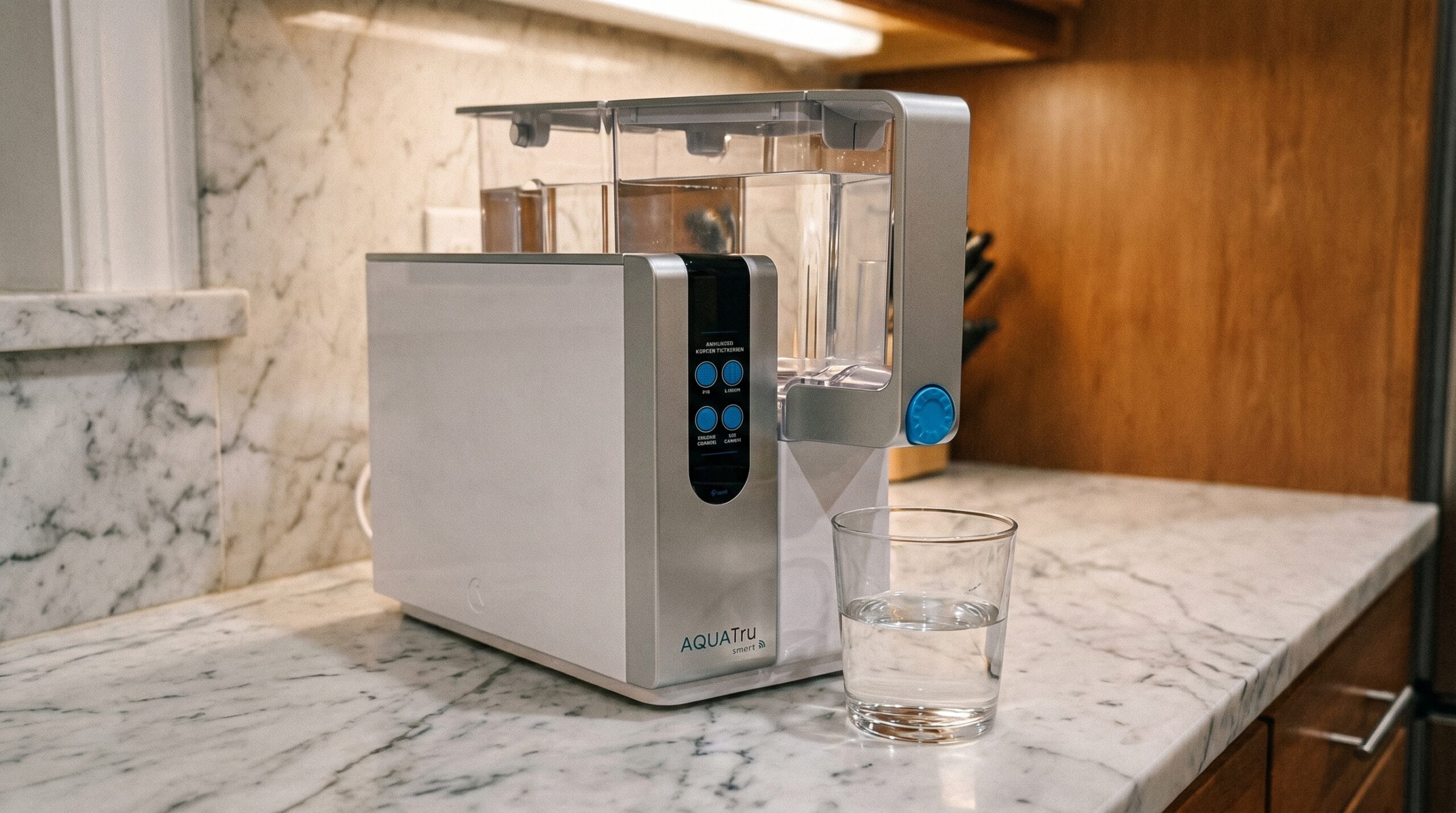
AquaTru requires a free counter spot and a power outlet. The unit runs a small electric pump to push water through the RO membrane, which is what gives it the efficiency and performance advantage over gravity-fed systems. Setup takes about 10 minutes per RO Filter Lab’s review. If you live in a studio with one outlet and no counter space, that is a real constraint worth thinking through before spending $449.
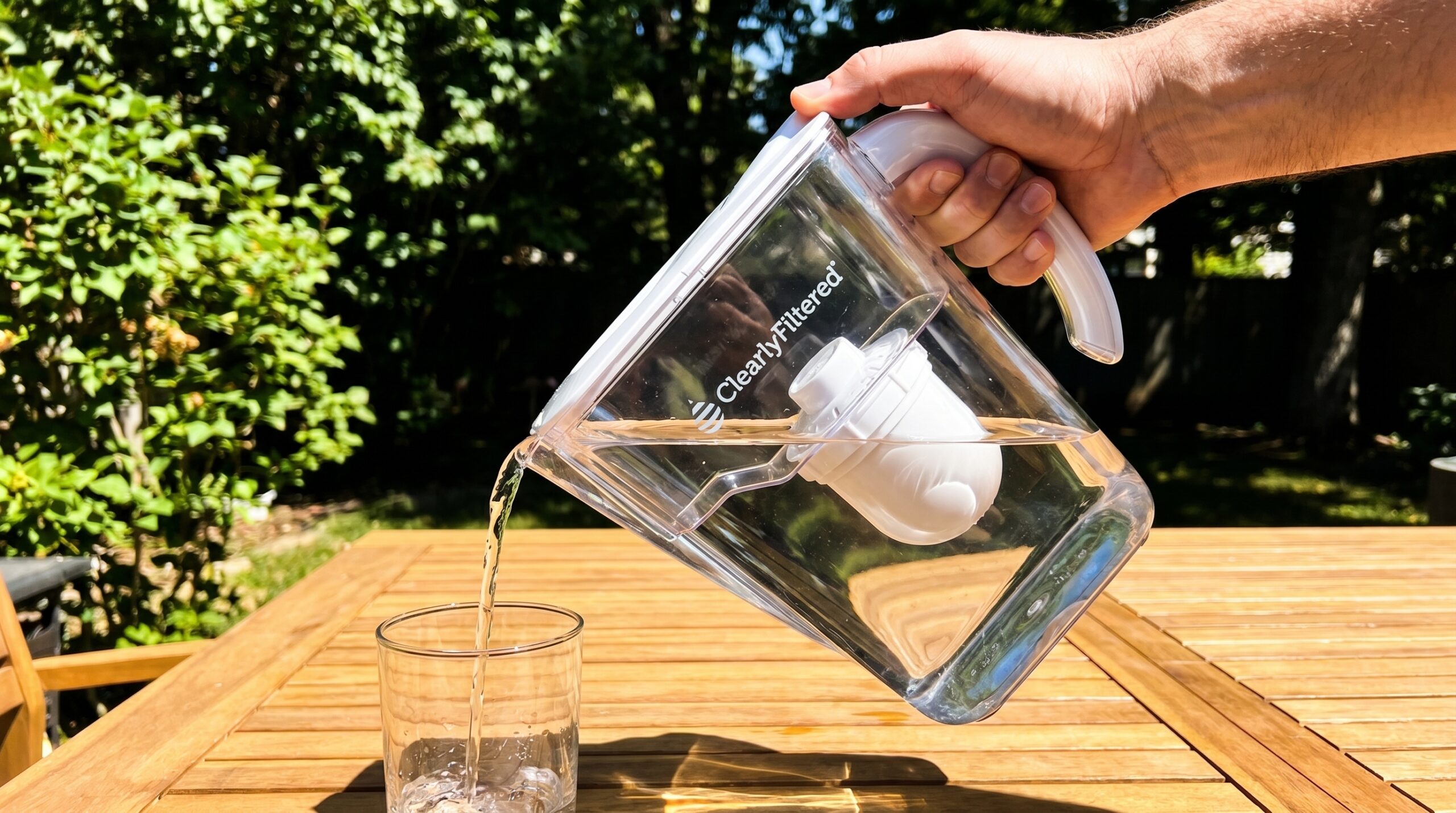
Clearly Filtered requires neither. It lives in the refrigerator, uses gravity, and has no moving parts. For a small apartment, a one-bedroom rental, or anyone who moves frequently, the fridge-door footprint is a genuine practical advantage. You pack it in a box and take it with you when the lease ends.
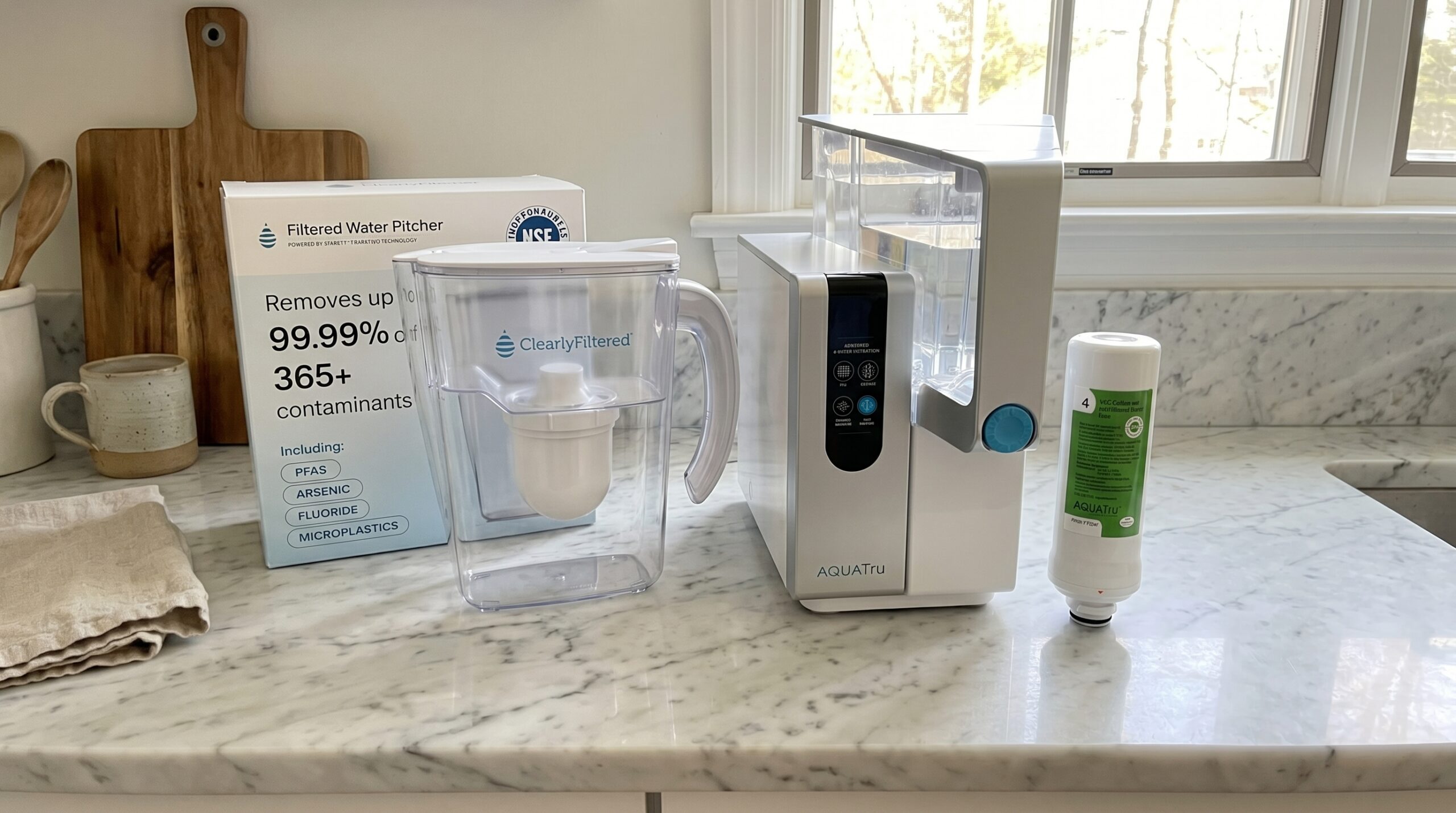
On output speed, AquaTru produces filtered water faster. Clearly Filtered filters at approximately 2.27 gallons per hour. For a single person or couple this is fine. For a household of three or more refilling the pitcher multiple times daily, the slower flow becomes friction.
The mineral retention difference is also real. AquaTru’s RO membrane strips everything, including calcium and magnesium. WaterFilterGuru’s testing measured a pH drop from 7.6 to 6.6 after AquaTru filtration. AquaTru sells a remineralizing filter as an add-on. Clearly Filtered retains beneficial minerals, though its cation exchange resin also increases sodium (+48%) and magnesium (+64%) while reducing calcium (32%) in the same testing. Neither product leaves your mineral profile exactly where it started.
What Most Articles Get Wrong About AquaTru vs Clearly Filtered
The most repeated error in AquaTru vs Clearly Filtered comparisons is the fluoride claim. Many articles state flatly that Clearly Filtered does not remove fluoride, positioning this as the decisive reason to choose AquaTru. That is factually wrong, and basing a $450 purchase decision on it is a problem.
Clearly Filtered removes fluoride. A peer-reviewed study confirmed it. WaterFilterGuru’s independent Tap Score testing confirmed it, taking fluoride from 1.1 ppm to non-detect. The correct framing is that AquaTru has certified fluoride removal, while Clearly Filtered has independently tested and peer-reviewed evidence of fluoride removal without an active certification currently behind it. Meaningful distinction, not the same as “it doesn’t remove fluoride.”
The second common error is treating “NSF certified” as a single undifferentiated status. AquaTru is certified to five standards. Clearly Filtered is certified to two. Those are not equivalent, and what each standard actually covers determines what you can verify, which is everything when you are making a decision about drinking water.
The third error is presenting AquaTru’s wastewater figure as settled. The manufacturer claims 0.6 to 0.75 gallons wasted per gallon purified. WaterFilterGuru independently measured a 4:1 ratio in some conditions. ModernCastle measured approximately 0.73:1, closer to the manufacturer figure. Real-world waste depends on your water pressure and temperature. The actual number for your unit may be higher than the marketing materials suggest. If water waste matters to you, that range is worth knowing.
The Real Cost of Running Each Filter
This is where the AquaTru vs Clearly Filtered comparison gets less obvious, because the cheaper product upfront becomes the more expensive one per gallon over time.
AquaTru costs $449 upfront and uses three separate filter cartridges on different replacement schedules. The pre/carbon filter runs every six months or 300 gallons. The VOC carbon filter runs every 12 months. The RO membrane runs every 24 months or 1,200 gallons, currently around $51 on Amazon (ASIN B077J8HMWP). Annual filter cost lands between $100 and $120. Cost per gallon works out to approximately $0.11 to $0.12 per WaterFilterGuru and ModernCastle’s independent analysis.
Clearly Filtered costs $100 upfront. Replacement filters are $55 each, $155 for a three-pack, or $305 for a six-pack. Each filter handles 100 gallons. Annual cost varies by household size and buying pattern, running $150 to $220 per year per WaterFilterGuru and FilterPicks. Cost per gallon is approximately $0.55, five times higher than AquaTru per gallon filtered.
| Filter | Upfront Cost | Annual Filter Cost | Total Year 1 Cost |
|---|---|---|---|
| AquaTru Classic | $449 | $100 to $120 | $549 to $569 |
| Clearly Filtered Pitcher | $100 | $150 to $220 | $240 to $310 |
AquaTru produces 0.6 to 0.75 gallons of wastewater per gallon purified per manufacturer specs, with independent testing measuring up to 4:1 in some conditions. Add roughly $2 per year in electricity. Clearly Filtered produces no wastewater and uses no electricity.
The crossover point where AquaTru becomes cheaper on total cost lands at approximately two to three years of regular household use. For renters on short leases, Clearly Filtered has the better economics. For anyone staying put for three or more years, the per-gallon gap compounds significantly in AquaTru’s favor.
If you are cooking with your filtered water as well as drinking it, the per-gallon cost difference becomes even more pronounced. At $0.11 per gallon, using AquaTru water for pasta, rice, and coffee is not a financial stretch. At $0.55 per gallon, it adds up faster than most people expect.
Who Should Buy the AquaTru Classic
Buy the AquaTru if certified fluoride removal is a firm requirement. It is the only no-installation countertop water filter for renters with IAPMO certification across five NSF standards. If your water report shows arsenic, chromium-6, or nitrates, it is the only option between these two that addresses them at certified levels.
Buy it if you plan to stay in your apartment for two years or more. The economics flip well before the three-year mark at normal household consumption, and you leave with a portable unit you can take to your next place.
The one thing to hold in mind: it needs counter space and a power outlet. If your kitchen cannot accommodate both, that settles it before the certification argument even starts.
AquaTru Classic
4.4 rating on Amazon
Who Should Buy the Clearly Filtered Pitcher
Buy Clearly Filtered if the $449 price point is a genuine barrier. At $100, it gets you into high-performance filtration including independently verified fluoride and PFAS reduction at a price most renters can absorb without much planning.
Buy it if your lease ends in under two years. The lower upfront cost and zero electricity or wastewater expense make the short-term economics straightforwardly better. Pack it when you leave.
Buy it if counter space and outlet access are actual constraints. A filter that lives in your refrigerator and runs on gravity is the most friction-free no-installation option available.
The one thing to hold in mind: Clearly Filtered’s PFAS certification is currently in transition. The independent testing data is strong, and the peer-reviewed fluoride evidence is solid. But if you have confirmed PFAS contamination in your local water and want a current active third-party certification covering it, that certification does not exist for this product right now. For context on what PFAS certification actually covers and why it matters, the EPA’s PFAS drinking water regulations page lays out the current regulatory picture.
Clearly Filtered Pitcher
4.2 rating on Amazon
If your water concern extends beyond drinking to every tap in the apartment, our countertop vs under-sink comparison covers how each setup stacks up across a three-year cost window, and what each can and cannot remove. If you are specifically dealing with lead in older building plumbing, our best under-sink water filter for lead guide includes two certified options that require zero drilling.
Questions You Might Have
Is AquaTru worth it for an apartment?
AquaTru is worth it for an apartment if you have counter space, a nearby outlet, and plan to stay for at least two years. It is the only no-installation option with IAPMO certification across five NSF standards covering fluoride, PFAS, lead, arsenic, and chromium-6. For renters who need verified broad-spectrum removal and have the upfront budget, nothing else at this category level matches it without requiring plumbing.
Does Clearly Filtered remove fluoride?
Clearly Filtered removes fluoride. A 2025 peer-reviewed study in the Journal of Public Health Dentistry (Hazzazi et al.) tested nine pitchers and found Clearly Filtered produced the single largest fluoride reduction of any filter in the study. WaterFilterGuru’s independent Tap Score testing confirmed fluoride reduction to non-detect levels. The manufacturer’s 99.54% claim is directionally accurate, though no pitcher achieves complete removal per the peer-reviewed data. There is currently no active NSF certification for fluoride removal attached to this product.
Which is better, AquaTru or Clearly Filtered?
AquaTru removes more contaminants at certified levels and costs less per gallon over time. Clearly Filtered costs less upfront and fits more living situations with no counter footprint or electricity requirement. AquaTru is the stronger choice if you need certified fluoride removal, if your water report shows arsenic or chromium-6, or if you plan to use the filter for three or more years. Clearly Filtered is the stronger choice if budget is the primary constraint or your lease timeline makes a $449 investment impractical.
Is Clearly Filtered NSF certified?
Clearly Filtered holds active NSF/ANSI 42 certification for chlorine taste and odor reduction, and NSF/ANSI 372 confirming lead-free materials construction. Its broader claims covering 365 contaminants, including PFAS, fluoride, and lead removal, are supported by independent lab testing but are not backed by active NSF or IAPMO performance certifications as of 2026. The brand is currently transferring its certification portfolio from WQA to NSF.
Does AquaTru waste a lot of water?
AquaTru’s manufacturer claims 0.6 to 0.75 gallons wasted per gallon purified. Independent testing produced a range: ModernCastle measured approximately 0.73:1, consistent with manufacturer claims, while WaterFilterGuru documented a 4:1 efficiency ratio in their testing conditions. Real-world waste depends on water pressure and temperature in your specific unit. Budget for higher waste than the best-case marketing figure suggests.
How long do Clearly Filtered filters last?
Each filter is rated at 100 gallons, which works out to roughly four months for a single person and two to three months for a household of three or more. Annual filter cost runs $150 to $220 depending on household size and whether you buy single filters or multipacks. The six-pack brings per-filter cost to roughly $50.83.
Is AquaTru vs Clearly Filtered even a fair comparison?
They solve the same problem for the same person: a renter who cannot install plumbing and needs real contaminant removal. But they use completely different technology at completely different price points. AquaTru is a countertop reverse osmosis system with a pump, a tank, and five NSF certifications. Clearly Filtered is a gravity-fed pitcher with a proprietary adsorption filter. The reason to compare them is that both sit at the top of the no-installation category. The reason they are not interchangeable is everything else.