
Quick fact: an NSF certified shower filter is rarer than the marketing suggests. As of a September 2026 database check, only six shower filter products from five manufacturers hold an actual NSF/ANSI 177 listing. Everything else claiming to be “tested to NSF 177,” “NSF-grade,” or simply “NSF certified” is making a claim NSF itself hasn’t verified.
That gap matters because NSF/ANSI 177 is the only standard that independently confirms a shower filter’s chlorine-removal claim. Without it, you’re trusting a brand’s word over lab data, and as you’ll see below, several brands’ own words don’t match what independent labs found when they tested the product.
You can scroll down straight to the best and most recommended 3 NSF Certified Shower Filter Picks.
Your Decision Guide
Who this is for:
- Anyone shopping for a shower filter specifically for chlorine odor, chlorine dryness, or skin and hair irritation who wants a verified pick instead of a marketing claim.
- Anyone who’s seen a brand say “NSF certified” or “tested to NSF 177” and wants to check whether that’s actually true.
- Anyone deciding between a $35 certified filter and a $165 uncertified one and wondering what the extra money buys.
Look elsewhere if:
- Households on chloramine-treated water — NSF/ANSI 177 doesn’t test chloramine reduction at all, and most shower filter media (KDF-55) barely touches it. If that’s your water, start with our best shower filter for chloramine guide instead.
- Anyone trying to solve lead, PFAS, or hardness at the shower head. A shower filter certification doesn’t cover those contaminants — see our breakdown of PFAS regulation in tap water for what actually requires a different standard entirely.
- Anyone who wants whole-house treatment rather than a single fixture fix.
What NSF/ANSI 177 Actually Certifies (and What It Doesn’t)
NSF/ANSI 177 certifies exactly one performance claim: free chlorine reduction, plus material safety. That’s the whole scope of a certified shower filter under this standard.
To earn certification, a filter has to reduce a 2.0 mg/L free-chlorine influent by at least 50% for its entire rated service life, tested at an elevated 40°C, with the influent cycled on and off in 15-minute intervals, at 80 psig dynamic pressure, at the manufacturer’s stated flow rate of at least 1.0 gpm. Testing stops if flow drops below that (NSF/ANSI 177 protocol).
Here’s what a certified shower filter is not verified to do, according to NSF’s own standard overview:
- Chloramine reduction — not tested
- Water hardness or mineral reduction — requires a separate ion-exchange standard (NSF/ANSI 44)
- Lead, PFAS, or heavy-metal reduction — that’s NSF/ANSI 53 territory, and no shower filter in this category holds a 53 certification
- Any hair, skin, or cosmetic outcome — there is no NSF performance claim tied to hair shedding, dryness, or skin appearance
Every “healthier hair and skin” claim you’ll see on a shower filter box sits outside what NSF/ANSI 177 actually measures. That doesn’t make the claim false. It makes it unverified by the certification being invoked to support it.
The Only 6 NSF Certified Shower Filters That Exist Right Now
A direct search of NSF’s public certification database for shower filtration systems, current as of September 2026, returns exactly six products from five manufacturers, all certified for free chlorine reduction only:
- Weddell Duo (WD-100).
- Purifull Shower Handle Filter.
- MOSAIC Shower Filter System-S / -SG.
- Coolang ACF Filter.
- Moolmang Vitamax Deluxe Dual Shower Filter (UMV-DS10CR).
That’s the entire list from NSF’s own database. Weddell Duo is also independently IAPMO-verified to NSF/ANSI 53 for PFAS and particulate reduction on top of its 177 certification — the only shower filter in this category with that additional layer.
You might notice one brand is missing from that list for a good reason, not a red flag: Sprite, maker of the widely sold Slim-Line 2, is certified to NSF/ANSI 177 through IAPMO R&T rather than NSF International directly. IAPMO and NSF are both ANSI-accredited certification bodies, and a product certified by one won’t show up in the other’s database. Sprite’s listing is confirmed in the IAPMO R&T listee directory. This is the exact confusion most roundup articles get wrong, more on that below.
Brands Using “Tested to NSF 177” Instead of Real Certification
This is where the shower filter certification landscape gets genuinely misleading. “Tested to NSF 177 standards” describes a lab test a brand paid for privately. It carries no ongoing manufacturing audit, no public listing, and no accountability if the brand’s claims drift from what that private test actually found. Here’s the brand-by-brand reality:
Jolie — Not certified. NSF issued a public notice dated April 10, 2024 after Jolie’s own FAQ stated the filter “is NSF Certified.” It isn’t. We’ve covered this specific brand in more depth in our Weddell Duo vs. Jolie shower filter comparison.
Canopy — Not certified. Markets “TRIPLE-ACTION FILTRATION TESTED TO NSF-177 STANDARDS.” No NSF or IAPMO listing exists for the product. We’ve evaluated Canopy against a bath-specific competitor in our Tubo vs. Canopy baby bath filter comparison, where the same certification gap applies.
Rorra — Not certified. Markets that it was “tested by multiple NSF Accredited Labs in accordance with NSF/ANSI 177 Standard protocols.” Being tested by an accredited lab is not the same as the finished product holding a certification, and Rorra holds neither.
Hello Klean — Not certified. Markets “Tested to exceed NSF-177 standards.” No listing found in either database.
Eskiin — Not certified, and this is the most serious case in the category. NSF confirmed directly that Eskiin “does not have any product certified by NSF and is not authorized to use the NSF certification mark or make any claims of NSF certification.” Eskiin acknowledged in April 2026 that it holds no certification while continuing to reference “independent testing to NSF/ANSI 177 standards.”
AquaBliss — Formerly claimed certification language on its product pages; that language has since been quietly removed. No current listing exists.
Filterbaby — Not confirmed certified. NSF issued a public notice on March 13, 2025 flagging that Filterbaby’s product page “claims to have passed requirements for NSF 42 and NSF 177.” No listing found in NSF’s or IAPMO’s database.
Aquasana (AQ-4100) — Not NSF/ANSI 177 certified. Aquasana’s only entries in NSF’s database are unrelated UV systems certified under a different standard entirely. Its shower filter line is marketed as “independently tested to NSF/ANSI Standard 177,” which the brand itself distinguishes from certification.
Second Shower — Partially certified, at the component level only. It holds NSF/ANSI 42 certification on its sediment pre-filter, but the full assembly’s chlorine and chloramine performance comes from the brand’s own independent lab testing, not a 177 certification on the finished product.
What Most Certified Shower Filter Guides Get Wrong
Three mistakes show up across nearly every roundup we checked while researching this piece.
They treat “absent from NSF’s database” as proof of no certification. Sprite is the counterexample, certified, just through IAPMO instead. Before calling any shower filter certification claim false, check both databases, not just NSF’s.
They cite the wrong source for Jolie’s zinc problem. Several sites attribute Jolie’s zinc-leaching finding to Mamavation. The actual source is WaterFilterGuru’s lab review, which measured filtered-water zinc increasing from 0.00919 PPM to 0.42455 PPM — an increase of more than 4,500%, attributed to the filter’s own zinc/copper KDF media leaching into the water it’s supposed to be cleaning. The same test found fluoride up over 6,000% and chlorine reduced by only 54%, well short of Jolie’s own 84%+ claim.
They don’t disclose test methodology, which makes conflicting results look like a contradiction instead of two different measurements. Mamavation’s field investigation ran each filter for 5–10 minutes and re-tested with a field kit, reporting Eskiin as “non-detect” for total chlorine. WaterFilterGuru’s controlled lab test, using a digital colorimeter against a fixed baseline, measured Eskiin at 0% chlorine removal. Both can be true — a quick field strip test and a controlled before/after lab measurement aren’t answering the same question, and neither number means anything without knowing which test produced it.
Independent Lab Results: What Chlorine Reduction Actually Looks Like
Chlorine removal is where the widest performance gap between certified and uncertified products shows up. In WaterFilterGuru’s controlled lab testing on municipal Colorado water: Weddell Duo removed 100% of chlorine, Afina removed roughly 99%, Canopy 97%, Filterbaby Pro 86%, Jolie 54%, AquaTru’s shower unit 44%, and Eskiin 0%.
Disinfection byproducts (DBPs) told an even starker story. Of a dozen-plus filters tested, only the Weddell Duo and AquaTru Shower brought DBPs below health-guideline levels. Filterbaby’s results were the outlier: it reduced one DBP by 100% while increasing another by 292%, to 8.32 PPB — the kind of inconsistent result that a real NSF/ANSI 177 certification process, with its audited testing protocol, is specifically designed to catch and prevent.
None of the shower filters tested reduced water hardness, regardless of what the marketing implied. That’s not a flaw specific to any one brand — it’s a limitation of the entire category. Removing calcium and magnesium requires ion exchange, which no shower-mounted filter contains.
3 NSF Certified Shower Filter Picks (and Who Each One Fits)
These three are ranked by verified certification status first, independent lab performance second. Products backed only by their own marketing claims aren’t included.
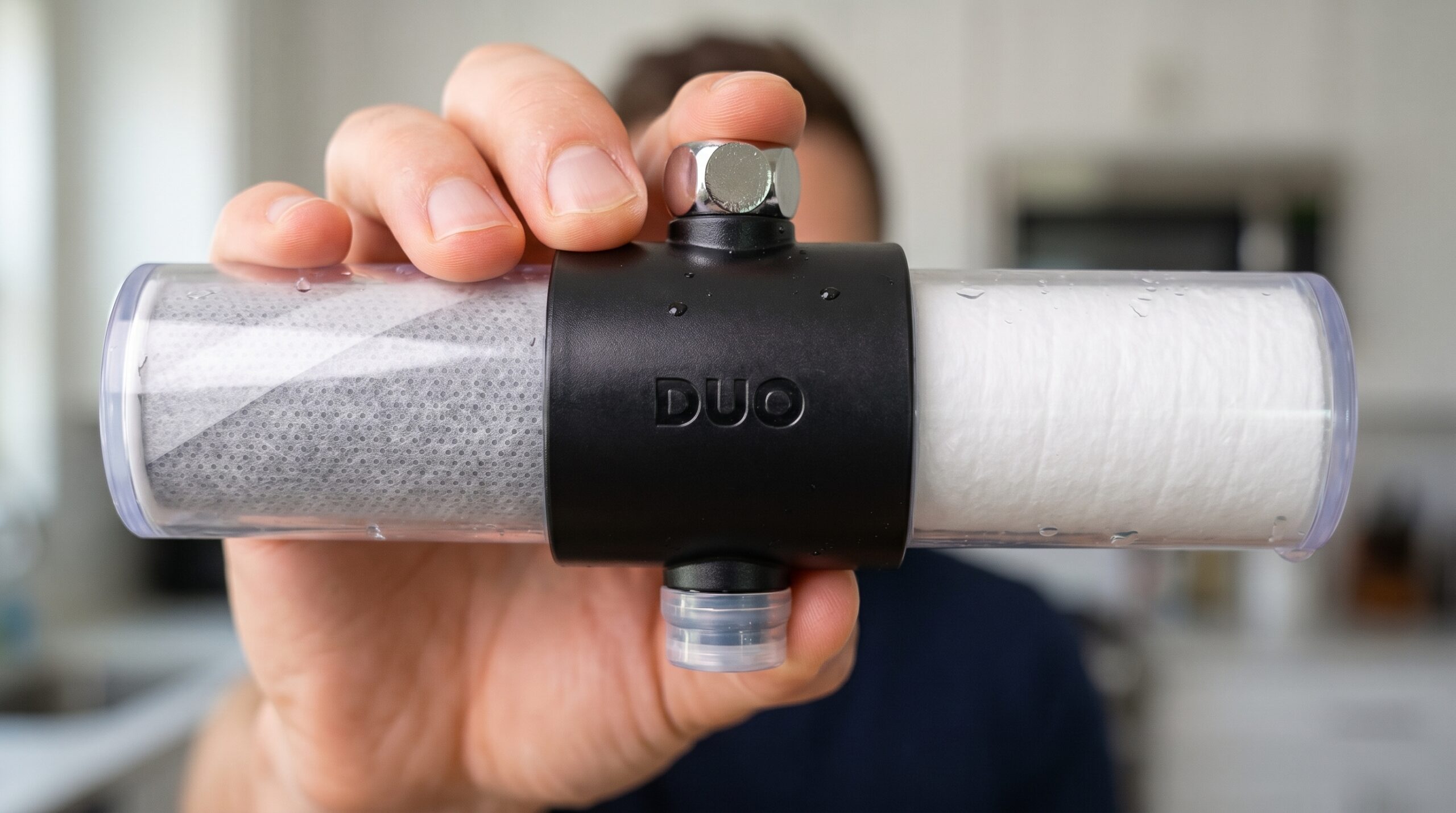
1. Weddell Duo Shower Filter — Best Overall NSF/ANSI 177 certified for free chlorine reduction, plus NSF/ANSI/CAN 372 lead-free certification, plus IAPMO-verified NSF/ANSI 53 for PFAS and particulate reduction, the only shower filter in this entire category with that third layer. In lab testing it removed 100% of chlorine and all four detected disinfection byproducts, the only filter to do both. Cartridges run roughly $0.012 per gallon, the lowest cost-per-gallon of any certified option. If you also care about microplastics specifically, our microplastics filtration guide explains why particulate certification is harder to find than most buyers realize.
Weddell Duo Shower Filter
3.9 rating on Amazon
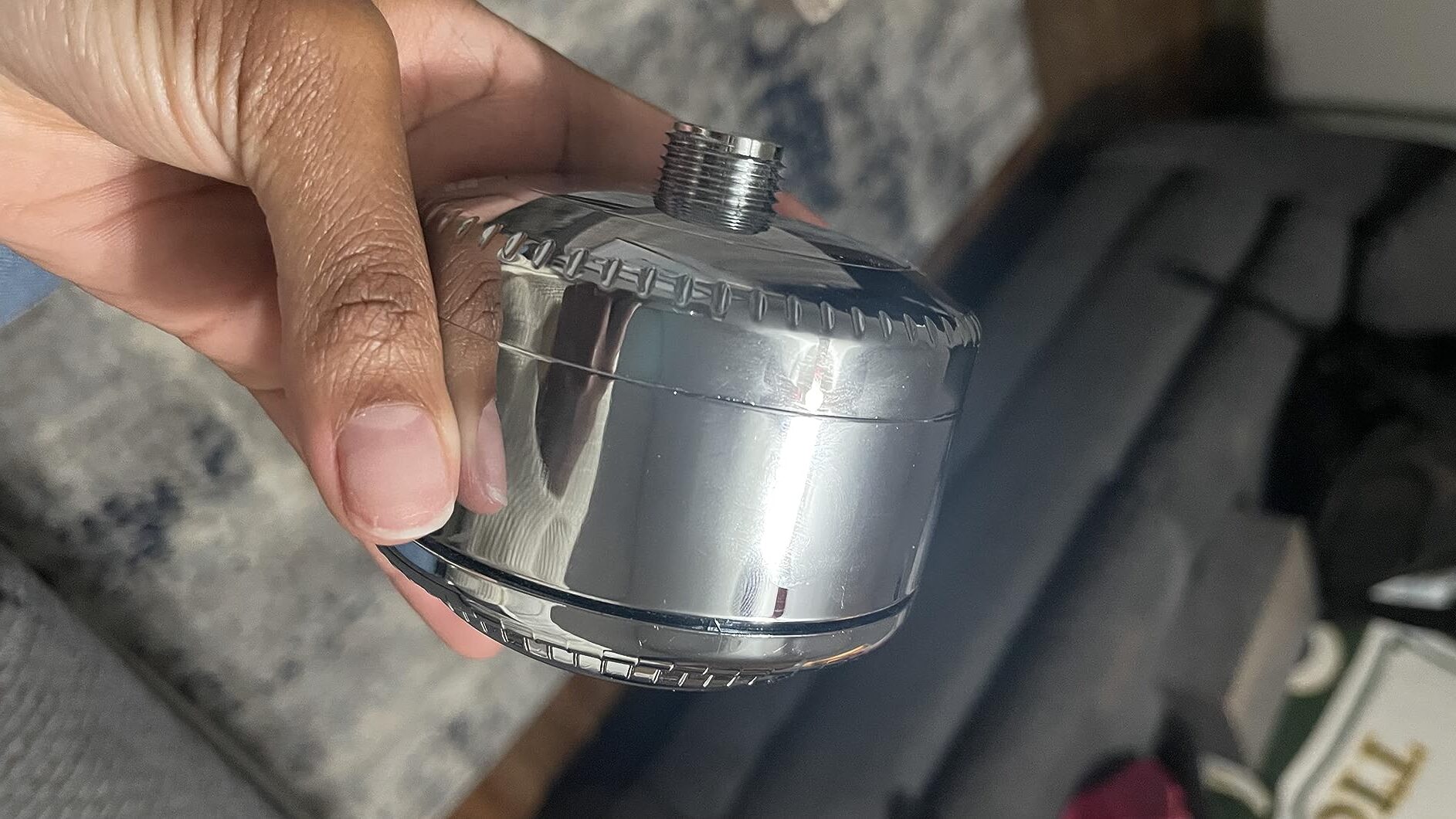
2. Sprite Slim-Line 2 — Best Budget Certified Pick NSF/ANSI 177 certified through IAPMO R&T. At roughly $35 with a 6-month, up to 10,000-gallon cartridge, it’s the lowest-cost genuinely certified shower filter on the market — about $0.007 per gallon. It only addresses free chlorine, with no DBP or hardness benefit, but for a buyer whose only concern is chlorine smell and dryness, it’s hard to beat on cost per verified gallon.
Sprite Slim-Line 2
4.4 rating on Amazon
3. Aquasana AQ-4100 — Best “Tested, Not Certified” Middle Option View on Amazon This one is not NSF/ANSI 177 certified, and it’s included specifically because it’s honest about that: Aquasana markets it as “independently tested to NSF/ANSI Standard 177” rather than claiming outright certification. It uses coconut-shell carbon plus KDF media and is rated to reduce over 90% of free chlorine across a 10,000-gallon, 6-month cartridge at roughly $0.022 per gallon. Reasonable option only if you understand going in that “tested” and “certified” aren’t the same claim.
Aquasana AQ-4100
4.3 rating on Amazon
Deliberately left off this list: Jolie, Canopy, Eskiin, Hello Klean, Rorra, Afina, Filterbaby, and AquaBliss. None holds a confirmed independent NSF/ANSI 177 certification, and several have independent test results — Eskiin’s 0% chlorine removal, Jolie’s zinc leaching, AquaBliss’s roughly 30% chlorine reduction — that actively contradict their own marketing.
Shower Filter Certification Costs: What You’re Actually Paying Per Gallon
| Product | Upfront Cost | Annual Filter Cost | Total Year 1 Cost |
|---|---|---|---|
| Weddell Duo (NSF certified) | $89.99 | ~$71.98 | ~$161.97 |
| Sprite Slim-Line 2 (NSF certified via IAPMO) | ~$35 | ~$35 (6-mo. cartridge) | ~$70 |
| Aquasana AQ-4100 (tested, not certified) | ~$60–90 | ~$40–50 | ~$100–140 |
| Jolie (tested to NSF 177, not certified) | $165 | ~$152 | ~$317 |
| Canopy (tested to NSF 177, not certified) | $150 | ~$148 | ~$298 |
| Filterbaby Pro (not confirmed certified) | $139 | ~$196 | ~$335 |
*These numbers are estimates and may or may not change based on your personal experience.
Several uncertified brands lock their advertised “lifetime warranty” behind an active auto-ship filter subscription, factor that into the real annual cost before assuming the upfront price is what you’ll actually pay.
Frequently Asked Questions
Is the Jolie shower filter NSF certified? No. Jolie is not NSF certified. NSF issued a public notice in April 2024 after Jolie’s own website stated it was certified, and independent lab testing found chlorine reduction of only 54%, well below the brand’s advertised figure.
What does NSF/ANSI 177 certification actually cover? NSF/ANSI 177 certifies free chlorine reduction and material safety only. It does not cover chloramine, hardness, lead, PFAS, or any hair or skin outcome, regardless of what a product’s packaging implies.
Does a shower filter remove chloramine? Most shower filter media, including the KDF-55 used in the majority of DTC brands, is largely ineffective against chloramine. NSF/ANSI 177 doesn’t test for it at all, and the EPA notes that roughly one-third of US public water systems use chloramine as their residual disinfectant.
How can I check if a shower filter is actually NSF certified myself? Search the product or brand name directly in NSF’s public database or IAPMO R&T’s listee directory. If it doesn’t appear in either, “tested to NSF 177” or similar language on the packaging is a private claim, not a certification.
Is Sprite’s shower filter certified even though it’s not in NSF’s database? Yes. Sprite’s Slim-Line 2 is certified to NSF/ANSI 177 through IAPMO R&T, a separate but equally accredited certification body. A product certified by IAPMO won’t appear in NSF’s own database, and vice versa — always check both before ruling a product out.
Is it worth buying an uncertified shower filter if it’s cheaper? It depends on what you actually need reduced. Some uncertified filters, like the Aquasana AQ-4100, are transparent about being tested rather than certified and perform reasonably in independent labs. Others, like Eskiin, have been independently measured at 0% chlorine removal despite marketing claims of 99%.